Poverty and social suffering
Les MisérablesPoverty and social suffering are both the subject of Les Misérables and a challenge the novel directs at society: deprivation is not simply a private misfortune, but a condition produced and intensified by social arrangements. Its effects range from hunger and insecure work to family separation, humiliation, and punishment. The book repeatedly asks how survival becomes a matter of moral judgment when people are denied the means to live, and its 1862 preface frames the persistence of ignorance and misery as a reason such a work may remain necessary.
Poverty as a social condition
The novel’s preface describes social damnation as something made artificially within civilization by laws and customs. It identifies three injuries of the century: the degradation of men through proletarian life, the downfall of women through hunger, and the stunting of children in darkness. This account gives poverty a broad reach. It operates not only through an empty purse, but through conditions that impair a person’s prospects and make vulnerability pass from one generation to the next. The image of social suffocation extends the diagnosis from individual hardship to a society that leaves some people without room to live securely.
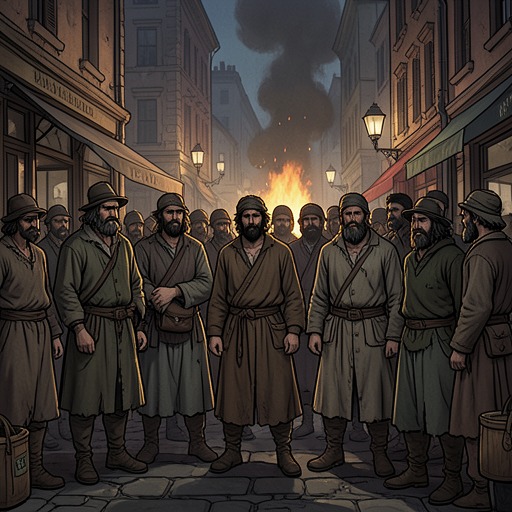
The historical panorama reinforces that argument. The novel moves across a France marked by the aftermath of Waterloo and the popular insurrections of June 1832, while registering changes in social power: aristocratic traditions represented by M. Gillenormand, commercial and industrial wealth embodied by M. Madeleine, and a poor laboring population exposed to exploitation. Yet poverty does not erase idealism or energy; the book associates those qualities with Marius and Little Gavroche as well. The contrast keeps the poor from becoming a faceless mass, even as it shows how economic hardship is connected to wider political and social change.
Hunger, survival, and punishment
Jean Valjean’s early life makes the connection between deprivation and criminal punishment concrete. He works seasonally pruning trees for eighteen sous a day and takes other kinds of labor when he can find them. His sister also works, but the family has seven children to support. When a harsh winter brings unemployment, the family has no bread. In 1795, Valjean breaks a baker’s shop window and takes a loaf. He is caught, tried for theft by breaking and entering at night, and sentenced to five years in the galleys. Four unsuccessful escape attempts extend his sentence to nineteen years.
The episode places the act, its cause, and its legal consequence in sequence without making them equivalent. Valjean’s theft is real, but the narrative sets it against a household pushed to hunger by lack of work. The sentence then becomes a second form of social force: punishment does not restore the family’s security or resolve the conditions that preceded the theft. The preface’s image of a penalty that pronounces a shipwreck finds an early human instance here, as a survival act becomes the beginning of a long exclusion from ordinary life.
Poverty’s unequal burdens
The hardships of Cosette’s mother show how poverty reaches into care for a child. Unable to meet mounting debts, she receives repeated letters from the couple caring for Ursule. One demands ten francs for a wool skirt because the child is inadequately clothed in cold weather. Cosette’s mother responds by selling her blond hair. Later, a letter claims that Ursule is ill and demands forty francs for medicine, threatening that the child will die if the money is not sent within eight days. The contrast between the demand and the mother’s inability to pay makes the pressure plain: her devotion is constant, but poverty limits what that devotion can accomplish. Her own cough and declining health accompany her hope that, once she is rich, she will have her daughter with her again.
Marius experiences a different but related form of deprivation after becoming indigent. He endures days without food, nights without sleep, weeks without work, insecure lodging, worn clothing, and the ridicule and humiliation attached to being poor. He sweeps the landing where he lives, buys a small piece of Brie, and waits until dusk to buy bread furtively. When he purchases a lamb chop for six or seven sous, he stretches it across three days, eating the meat first, then the fat, then the bone. His aunt sends him sixty pistoles, but he repeatedly returns the money, insisting that he needs nothing. These details show deprivation as a daily discipline of scarcity, while his refusal of assistance makes the preservation of dignity part of his struggle. The narrative presents such private endurance as a kind of unrecognized battle, not as proof that poverty is harmless or desirable.
From diagnosis to public responsibility
Victor Hugo gives the question an explicitly political form in his speech to the Legislative Assembly on 9 July 1849. Speaking in support of Armand de Melun’s proposal for a committee to prepare laws establishing public provision and assistance, he distinguishes suffering from misery: suffering may be a divine law, he argues, but misery can be destroyed. He insists on the force of that distinction, rejecting mere reduction or limitation as an adequate goal. The reactions recorded around the speech register opposition on the right and agreement on the left, making the Assembly itself a scene of disagreement over whether poverty is inevitable or subject to public action.
Hugo’s argument makes the capacity to act the measure of political duty: if an achievable task remains undone, duty remains unfulfilled. He points to families in Parisian districts living together amid extreme deprivation, and calls on lawmakers and governors to keep the possibility of ending misery in view. This public claim gathers the novel’s individual stories into a shared social question. Valjean’s hunger, Cosette’s mother’s sacrifices, and Marius’s precarious survival are not interchangeable experiences, but each exposes the distance between the need to live and the support society provides.
The work’s account of poverty therefore joins narrative compassion to a demand for social progress. It treats exclusion and precarious labor as continuing questions, and its critical framing notes that child abuse and extreme insecurity remain concerns even where children no longer face precisely the circumstances of Ursule and Little Gavroche. The novel does not resolve the gap between its hope for progress and the persistence of hardship; instead, it leaves that gap as a reason to ask what remains to be done.